The Need for Attention to See Change
What's the Difference between Looking and Seeing?
A large fraction of traffic accidents are of the type "driver looked but
failed to see". Here, drivers collide with pedestrians in plain view, with
cars directly in front of them (the classic "rear-ender"), and even run
into trains. (That's right -- run into trains, not the other way
around.) In such cases, information from the world is entering the driver's
eyes. But at some point along the way this information is lost, causing
the driver to lose connection with reality. They are looking but they
are not seeing.
What's going on? Our findings indicate that the critical factor is attention:
To see an object change, it is necessary to attend to it.
To show this, we developed a flicker paradigm in which
an original and a modified image continually alternate, one after the other,
with a brief blank field between the two (see Figure 1 below). The onset
of each blank field swamps the local motion signals caused by a change,
short-circuiting the automatic system that normally draws attention to
its location. Without automatic control, attention is controlled entirely
by slower, higher-level mechanisms which search the scene, object by object,
until attention lands upon the object that is changing. The change
blindness induced under these conditions is a form of invisibility:
it can become very difficult to see a change that is obvious once attended.
To see this effect for yourself, try out the following:
Examples that can be viewed or downloaded
(as QuickTime movies)
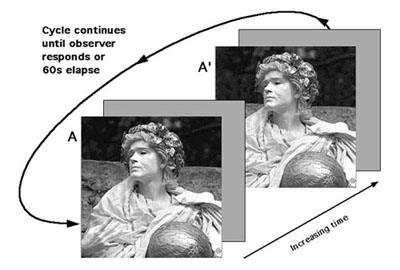
Figure 1. General design of the flicker paradigm. The change
in the image (here, the movement of the background wall) is difficult to
notice under these conditions -- observers will often look at but not see
the changing object. This difficulty can remain even after observing the
images for several seconds, showing that a detailed representation of the
scene is not being stored in memory. However, once attention has "latched
onto" the appropriate object, the change is easy to see.
Research Papers
- Rensink RA (2004). Visual sensing without seeing. Psychological Science, 15: 27-32.
- Rensink RA (2002). Internal vs. external information in visual perception. Proceedings of the Second International Symposium on Smart Graphics: 63-70. [Smart Graphics 2; Hawthorne, NY, USA.]
- Rensink RA (2002b).
Changes. Progress in Brain Research, 140: 197-207.
- Rensink RA (2001). Change blindness: Implications for the nature of attention. In MR Jenkin and LR Harris (eds.), Vision and Attention (pp. 169-188). New York: Springer.
-
Rensink RA (2000a). The Dynamic Representation
of Scenes. Visual Cognition, 7:17-42.
-
Rensink RA (2000b). Visual Search for Change:
A Probe into the Nature of Attentional Processing. Visual Cognition, 7:345-376.
-
Rensink RA, O'Regan JK, and Clark JJ (2000).
On the Failure to Detect Changes in Scenes Across Brief Interruptions.
Visual Cognition, 7:127-145.
-
Rensink RA, O'Regan JK, and Clark JJ (1997).
To See or Not to See: The Need for Attention to Perceive Changes in Scenes.
Psychological Science, 8:368-373.
Review Articles / Opinion Pieces
- Rensink RA (2010). Seeing seeing. Psyche, 16: 68-78.
- Rensink RA (2008). On the applications of change blindness. Psychologia, 51: 100-106. (Introduction to special issue on change blindness).
-
Simons DJ, and Rensink RA (2005).
Change blindness: Past, present, and future. Trends in Cognitive Sciences, 9:16-20.
-
Rensink RA (2002a). Change Detection. Annual
Review of Psychology, 53:245-277.
- Rensink RA (2000d). When good observers go bad: Change blindness, inattentional blindness, and visual experience. Psyche, 6, http://psyche.cs.monash.edu.au/v6/psyche-6-09-rensink.html.
-
Rensink RA (2000c).
Seeing, Sensing, and Scrutinizing.
Vision Research, 40: 1469-1487.
Encyclopedia Articles
- Rensink RA (2011). Change blindness. In Scholarpedia. (To appear Dec 2011.)
- Rensink RA (2010). Attention. In McClelland, J. and Lambon-Ralph, M. (eds), Cognitive Neuroscience: The Biomedical & Life Sciences Collection. London: Henry Stewart Talks Ltd.
- Rensink RA (2009a). Change Detection. In E. Bruce Goldstein (ed). Encyclopedia of Perception. Thousand Oaks CA: Sage Publications.
- Rensink RA (2009c). Attention: Change Blindness and Inattentional Blindness. In W. Banks (ed). Encyclopedia of Consciousness, Vol 1. New York: Elsevier. pp. 47-59.
- Rensink RA (2005a). Change blindness. In L. Itti, G. Rees, and J.K. Tsotsos (eds). Neurobiology of Attention. (pp. 76-81). San Diego, CA: Elsevier.
- Rensink RA (2005b). Change blindness. In McGraw-Hill Yearbook of Science & Technology (2005). (pp. 44-46).
New York: McGraw-Hill.
- Rensink RA (2003). Visual attention. In L Nadel (ed.), Encyclopedia of Cognitive Science. (pp. 509-515). London: Nature Publishing Group.
- Rensink RA (2000). Scene perception. In AE Kazdin (ed.), Encyclopedia of Psychology, vol. 7. (pp. 151-155). New York: Oxford University Press.
And if you liked this...
check
out the Change Detection
Database.
Back to Ronald Rensink home page
Last updated 20 Nov 2011.